Central schedule board
A calendar-style board showing all classes, lanes and instructors, with filters by date, event type and range.

Replacing spreadsheets and manual coordination with a centralised, real-time scheduling platform that keeps classes, coaches and ranges perfectly in sync.
Share your current scheduling, operations or product challenges and we'll respond within 24–48 hours with practical next steps.
About the client & context
The client runs a fast-growing shooting academy offering safety courses, training sessions and events for newcomers and experienced shooters. As bookings increased and new formats were introduced, managing daily schedules using spreadsheets and email threads became risky and time-consuming.
Multiple instructors, multiple ranges and hundreds of students every month meant the team needed a reliable way to coordinate classes, lanes and equipment. They wanted a solution that would work in multiple languages, respect strict safety rules and still be simple enough for non-technical staff to use every day.
The challenge
Before the custom web application, the academy relied on spreadsheets and scattered notes to manage daily schedules. As the business grew, admins were constantly firefighting: checking availability, resolving double bookings and manually notifying instructors and students.
This is often the point where generic tools and makeshift processes start to slow down growth. Our first step is to map the real-world workflows and understand where time is lost, where mistakes happen and what is blocking the team from scaling with confidence.
Goals & success criteria
Clear goals upfront help us make intentional trade-offs during UX and engineering, and define what “successful launch” actually means for the client team.
Eliminate double bookings and scheduling conflicts for lanes, instructors and classes.
Give admins real-time visibility into today’s schedule and upcoming weeks.
Improve utilisation of instructors and ranges to increase revenue per available slot.
Reduce time spent on manual coordination and status updates.
Design an intuitive scheduling interface that non-technical staff can learn in a single session.
Implement a robust, role-based access model for admins, instructors and support staff.
Support multiple languages and flexible event types without changing core code.
Build on a scalable Laravel architecture with clean APIs for future mobile apps or integrations.
We agreed on a phased rollout: launch a focused MVP for the primary range, validate the flows with real staff and then extend the system to new use cases and reporting needs.
Our solution
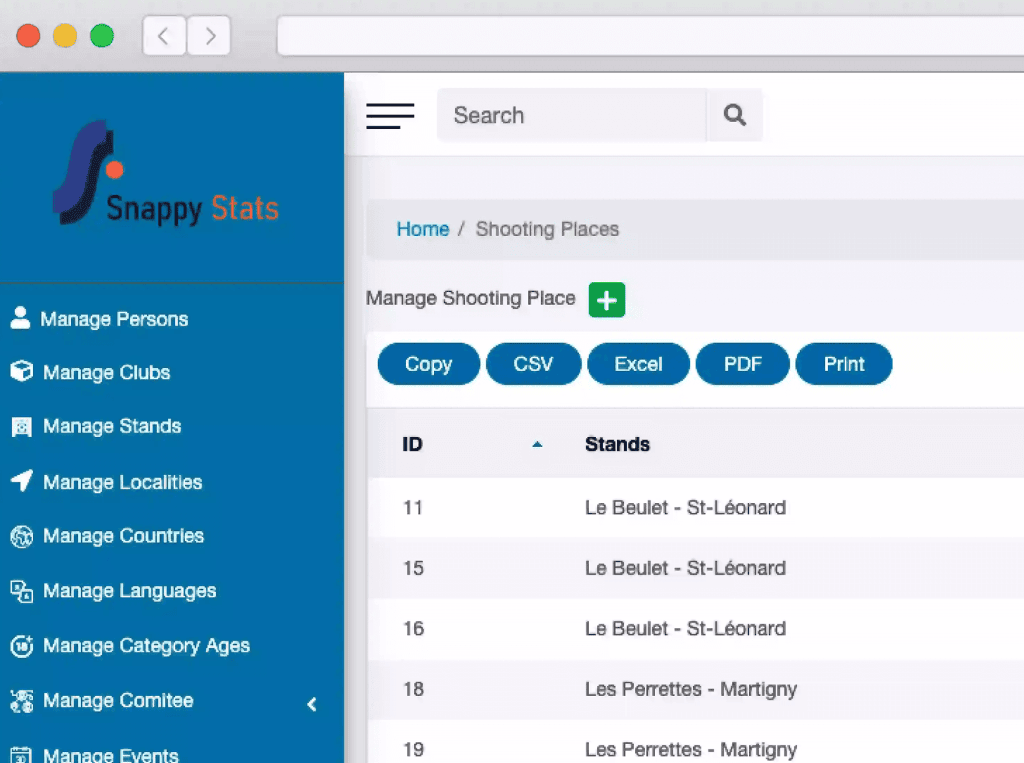
QalbIT partnered with the academy to design and deliver Snappy Stats – a custom scheduling management web application built specifically for how shooting ranges operate.
We started with collaborative discovery workshops, mapping real-world scenarios such as safety courses, private sessions and group events. From these, we designed a central schedule board with role-based views, streamlined booking flows and automated conflict checks. The application is built on Laravel with a modular architecture, making it easy to add new event types, locations and reporting modules over time.
Product features & UX
Everything the academy team needs to keep classes, lanes and instructors perfectly aligned – in one place.
A calendar-style board showing all classes, lanes and instructors, with filters by date, event type and range.
Separate views for admins, instructors and support staff with permissions aligned to safety and operational policies.
Automatic checks to prevent double booking of lanes, instructors or equipment when creating or editing events.
Simple flows to register participants, capture key details and track attendance across sessions.
Pre-defined templates for popular course types, making it faster to schedule recurring classes and events.
Overview reports for bookings, cancellations and utilisation, giving management better data for planning.
Configurable labels and content so the system can support staff in multiple languages as the academy grows.
Optimised layouts for desktop and tablet, ensuring staff can manage schedules from the office or directly on the range.
Each feature is designed to slot into the team's existing workflows – with just enough structure to reduce errors, but not so much friction that adoption becomes a struggle.
Architecture & stack
The technology stack is deliberately simple, maintainable and aligned with the team's long-term roadmap — powerful enough for today's needs without locking the product into unnecessary complexity.
Laravel / PHP application layer following modular architecture.
MySQL database with well-indexed tables for schedules, resources and activity logs.
REST APIs prepared for future integrations or mobile apps.
Role-based access control and audit trails for safety and compliance.
Environment-based configuration for staging vs. production deployments.
Responsive web UI, implemented with Tailwind CSS utility-first styling.
Clear information hierarchy for schedules, resources and filters.
Reusable components for cards, timelines, tables and forms.
Accessibility-aware design with high contrast and keyboard-friendly flows.
We favour stacks that your in-house team or future partners can understand and extend — with clear boundaries between frontend, backend and integrations so the product can evolve without constant rewrites.
Delivery process & collaboration
We favour a transparent, iterative delivery model with enough structure to keep momentum, and enough flexibility to adjust as we learn from real usage.
Stakeholder workshops, review of existing spreadsheets and on-range processes, and definition of core scheduling flows.
User journeys for admins and instructors, wireframes for the schedule board and design of key screens using the QalbIT design system.
Incremental backend and frontend delivery with regular demos, feedback loops and environment-ready deployments.
Rollout to a subset of classes and instructors, close monitoring of edge cases and improvements to conflict resolution logic.
Rollout to all lanes and classes, plus follow-up iterations on reports, templates and multi-language support.
Each step includes regular demos, async updates and clear ownership so both teams know what is happening, what is blocked and what is coming next.
Results & impact
From reactive firefighting to proactive, data-informed scheduling.
80% fewer double bookings
Measured after the first three months of using the new scheduling board.
3–4 hours saved per week
Less time spent manually coordinating changes and confirming availability.
100% centralised view
All upcoming sessions, lanes and instructors managed from one system.
Ready for multi-location rollout
Architecture prepared for new ranges and additional reporting modules.
Even when exact numbers are directional, we anchor results to the original project goals so stakeholders can clearly see what changed after launch.
By replacing spreadsheets with a purpose-built Laravel web application, the academy team gained control over their daily operations. Conflicts dropped, staff had a clear view of their day and management finally had reliable data to plan growth. The same foundation can now support new locations, formats and integrations as the business scales.
“With Snappy Stats, our team finally has one reliable place to see what is happening today and in the weeks ahead. We spend less time fixing mistakes and more time focusing on safe, high-quality training for our members.”
Planning to modernise scheduling for your academy or training business?
Talk to QalbIT about a custom solution