Quick reminder capture
Create one-off or recurring reminders in a few taps with clear categories and contextual icons.

A cross-platform reminder and notification app that helps users stay on top of bills, tasks, events and life moments – with recurring reminders, templates and secure, reliable delivery.
Share your current scheduling, operations or product challenges and we'll respond within 24–48 hours with practical next steps.
About the client & context
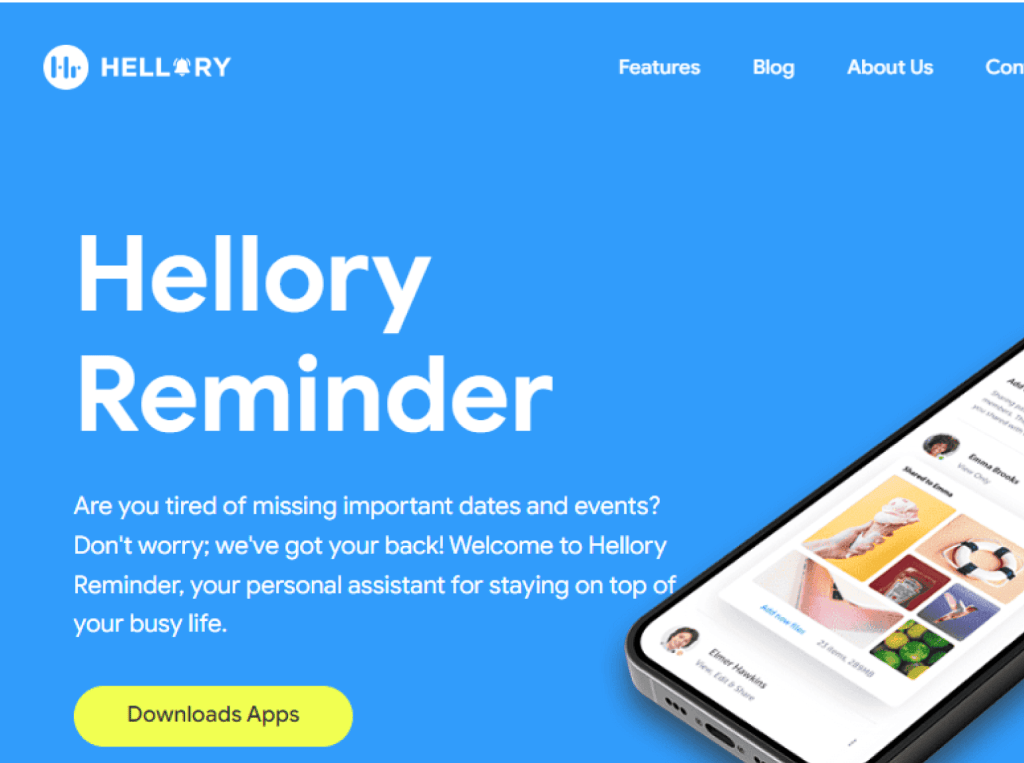
When the client approached us with the Hellory Reminder project, they had a clear vision: create a personal assistant that would help users stay on top of their busy lives by providing seamless, flexible reminders across channels.
The goal was to build an intelligent reminder application that went beyond one-off alarms. Hellory needed to handle recurring reminders, flexible schedules, and different categories such as bills, events, habits and to-dos. At the same time, the team wanted a delightful mobile experience that felt approachable and trustworthy, especially for users who rely on the app for important life events. QalbIT partnered with the founders to turn this vision into a production-ready cross-platform mobile app backed by a secure API.
The challenge
Most users in the target audience juggled multiple reminder tools – phone alarms, simple to-do apps and ad-hoc notes. None of these provided a unified, context-aware reminder experience. The founders wanted Hellory to become a “single place to remember everything” without overwhelming users with complex settings.
This is often the point where generic tools and makeshift processes start to slow down growth. Our first step is to map the real-world workflows and understand where time is lost, where mistakes happen and what is blocking the team from scaling with confidence.
Goals & success criteria
Clear goals upfront help us make intentional trade-offs during UX and engineering, and define what “successful launch” actually means for the client team.
Launch Hellory as a flagship consumer app that clearly communicates its “smart reminder for busy lives” positioning.
Win early adopters through a polished, reliable mobile experience that encourages daily use and positive reviews.
Create a foundation for future monetisation models such as premium templates, categories or shared reminder spaces.
Collect anonymised product analytics to inform future roadmap decisions.
Design a reminder UX that makes recurring schedules and categories easy to set up and manage.
Implement a robust scheduling engine that can handle thousands of reminder events per user without conflicts.
Support cross-platform mobile delivery using Flutter, backed by a secure Node.js / MongoDB API.
Integrate push notifications via Firebase Cloud Messaging while keeping battery usage and data consumption low.
Build an admin console to manage categories, templates, marketing content and feature flags.
We aligned on an MVP scope that focused on core reminder workflows, then reserved more advanced automation and sharing features for later phases after the initial launch.
Our solution
QalbIT designed and shipped Hellory as a cross-platform smart reminder app with a purpose-built scheduling engine and a clean, approachable mobile UX.
We began with user journey mapping, identifying the most common reminder scenarios – paying bills, health check-ups, recurring events and personal habits. These flows informed the information architecture and onboarding experience. On the technical side, we implemented a Node.js / Express API with a MongoDB data model optimised for recurring events and notification queues. The Flutter app communicates with this API through secure REST endpoints, while Firebase Cloud Messaging delivers push notifications across Android and iOS. An internal admin panel allows the team to manage categories, featured templates and in-app content without shipping new builds.
Product features & UX
Everything users need to capture, organise and act on reminders – in one smart reminder app.
Create one-off or recurring reminders in a few taps with clear categories and contextual icons.
Support for daily, weekly, monthly and custom schedules so users can set and forget regular tasks.
Pre-built templates for bills, renewals, health check-ups and personal goals that reduce setup time.
Push notifications with quick actions to mark done, snooze or reschedule without opening the full app.
Colour-coded categories and tags so users can group reminders for work, home, finances, health and more.
User data stored securely in the cloud with device-level encryption and protected APIs.
Guided content that helps new users understand how to get value from the app within the first session.
A supporting marketing site for Hellory with product storytelling, screenshots and app-store links.
Each feature is designed to slot into the team's existing workflows – with just enough structure to reduce errors, but not so much friction that adoption becomes a struggle.
Architecture & stack
The technology stack is deliberately simple, maintainable and aligned with the team's long-term roadmap — powerful enough for today's needs without locking the product into unnecessary complexity.
Node.js / Express application layer modelling users, reminders, schedules and notification queues.
MongoDB database with schemas optimised for recurring events and efficient querying of upcoming reminders.
REST / JSON APIs secured with token-based authentication for the mobile apps.
Scheduling & worker processes that enqueue and dispatch notifications via Firebase Cloud Messaging.
Environment-specific configuration for staging and production with CI-driven deployments.
Flutter codebase targeting Android and iOS with a shared component library.
Design system aligned with Hellory branding for typography, colour and motion.
Responsive marketing website built with HTML5, CSS and lightweight JavaScript.
Accessibility-minded layouts, including readable contrast and touch-friendly tap targets.
We favour stacks that your in-house team or future partners can understand and extend — with clear boundaries between frontend, backend and integrations so the product can evolve without constant rewrites.
Delivery process & collaboration
We favour a transparent, iterative delivery model with enough structure to keep momentum, and enough flexibility to adjust as we learn from real usage.
Clarified the product vision, user personas and priority reminder scenarios; translated ideas into a validated MVP scope.
Designed onboarding, reminder creation, templates and notification flows using low-fidelity wireframes and high-fidelity screens.
Implemented the Node.js / MongoDB API and Flutter mobile apps in parallel, with weekly demos and feedback loops.
Released a beta to a closed group of users, captured analytics and qualitative feedback, and refined templates and notification tuning.
Prepared the app-store listings, launched publicly and continued improving reliability, performance and feature depth.
Each step includes regular demos, async updates and clear ownership so both teams know what is happening, what is blocked and what is coming next.
Results & impact
From scattered reminders to a single smart assistant for busy lives.
Steady growth in active users after launch
A clear value proposition and smooth onboarding helped the app win and retain early adopters.
High success rate for scheduled notifications
The scheduling engine and infrastructure delivered reminders consistently across devices and time zones.
Frequent repeat usage
Users returned regularly to manage routines, bills and personal goals through the app.
Platform ready for premium features
The architecture supports future monetisation, analytics and integrations without major rewrites.
Even when exact numbers are directional, we anchor results to the original project goals so stakeholders can clearly see what changed after launch.
Launching Hellory as a polished reminder app helped the founders validate their idea with real users and establish a credible presence in the productivity space. With cross-platform apps, a reliable notification pipeline and structured analytics in place, the team now has a solid foundation to iterate on features, positioning and growth experiments.
“QalbIT helped us turn a broad idea — a reminder app for busy lives — into a focused product we could confidently ship. The team supported us across UX, mobile and backend, and the result feels both robust and user-friendly.”
Planning to build a reminder app, habit tracker or notification-heavy mobile product?
Talk to QalbIT about your mobile app idea