Role-based dashboards
Dedicated workspaces for recruiters, employers and candidates – each showing only the information and actions they need.

A custom-built recruitment platform that centralises employers, vacancies and candidates, makes CVs searchable and gives HR professionals a single source of truth for every hiring process.
Share your current scheduling, operations or product challenges and we'll respond within 24–48 hours with practical next steps.
About the client & context
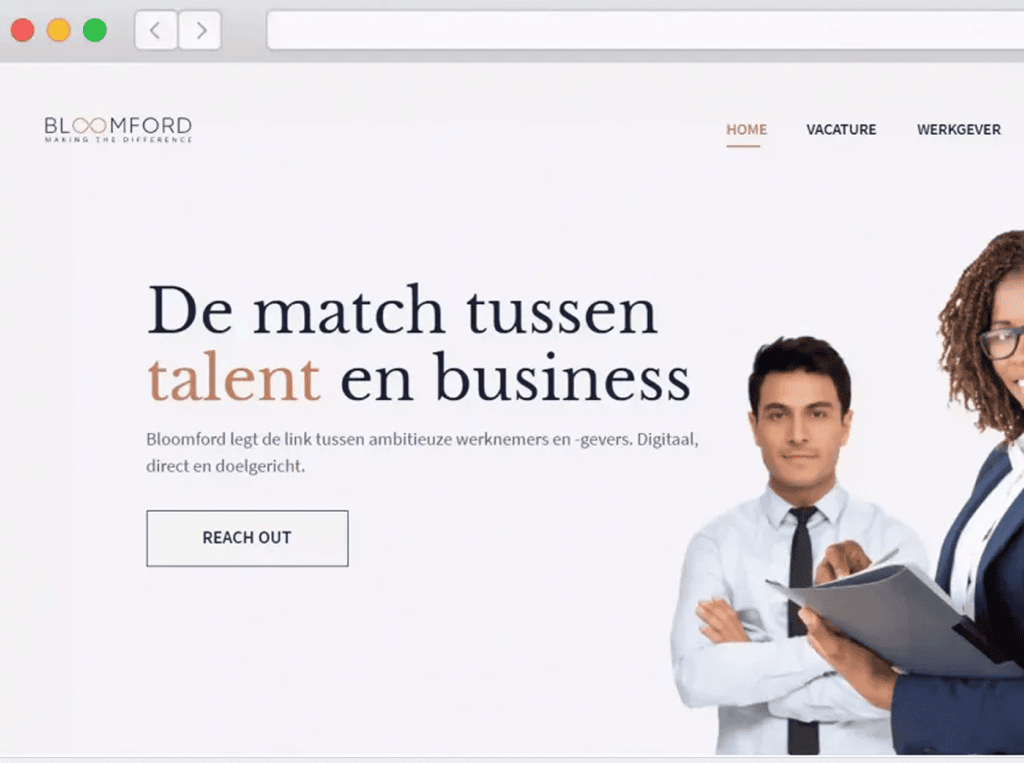
Bloomford is a recruitment brand focused on matching ambitious talent with the right business environment. Working primarily with HR professionals, they help organisations in Belgium find, assess and hire candidates across multiple roles and seniority levels.
Before launching the Bloomford platform, the team worked through traditional channels: email, spreadsheets, off-the-shelf job boards and manual follow-ups. They wanted to offer HR teams something better – a hiring portal built around recruiters’ workflows, where employers, vacancies and candidates live in one structured workspace instead of scattered across tools.
The challenge
The recruitment team juggled multiple channels – job boards, email, LinkedIn messages and offline referrals. CVs arrived as attachments, got stored in various folders and were hard to search. Employers had little visibility on the status of their vacancies, and candidates did not have a clear, branded portal to follow their applications.
This is often the point where generic tools and makeshift processes start to slow down growth. Our first step is to map the real-world workflows and understand where time is lost, where mistakes happen and what is blocking the team from scaling with confidence.
Goals & success criteria
Clear goals upfront help us make intentional trade-offs during UX and engineering, and define what “successful launch” actually means for the client team.
Launch a hiring portal that HR professionals trust as their daily workspace for vacancies and candidates.
Shorten time-to-shortlist by making candidate search, filters and matching much faster.
Give employers a clear view of their open positions, pipeline stages and shortlisted candidates.
Create a consistent, branded experience for candidates – from application to placement.
Design role-based dashboards for admins, recruiters, employers and candidates.
Implement structured candidate profiles with CV parsing to reduce manual data entry.
Support multi-language vacancies and content for Belgium’s multilingual market.
Build a modular PHP/MySQL platform with APIs ready for future ATS or HRIS integrations.
We agreed on a phased rollout: first launch an MVP focused on core employer and candidate flows, then extend the platform with advanced search, reporting and integrations once real-world usage validated the approach.
Our solution
QalbIT partnered with Bloomford to design and build a custom hiring portal that acts as a lightweight, ATS-style platform for HR professionals.
We started by mapping the full hiring journey for each user type: recruiters, employers and candidates. From there, we defined the information architecture and UX for dashboards, vacancy management and candidate profiles. The resulting platform combines structured data models, CV parsing and intuitive search so recruiters can move from CV intake to shortlist in a fraction of the time. Built on a PHP/MySQL stack with REST APIs, the application is ready for future integrations with external job boards, HR suites and analytics tools.
Product features & UX
Everything HR teams need to centralise vacancies, candidates and hiring workflows in one recruitment platform.
Dedicated workspaces for recruiters, employers and candidates – each showing only the information and actions they need.
Create, publish and manage jobs with structured fields, multi-language support and visibility controls per employer.
Convert uploaded CVs into structured profiles with experience, skills and education, reducing manual data entry.
Fast search across the candidate pool with filters by location, skills, experience level and more.
Store employer details, contacts and past vacancies in one place, giving recruiters full context before every conversation.
Track candidates across stages – applied, shortlisted, interview, offer – with activity logs and status updates.
Email notifications and on-platform updates to keep candidates, employers and recruiters aligned on next steps.
Baseline reporting for open roles, pipeline stages and recruiter activity, ready to be extended with deeper analytics.
Each feature is designed to slot into the team's existing workflows – with just enough structure to reduce errors, but not so much friction that adoption becomes a struggle.
Architecture & stack
The technology stack is deliberately simple, maintainable and aligned with the team's long-term roadmap — powerful enough for today's needs without locking the product into unnecessary complexity.
PHP-based modular application layer designed around employer, vacancy and candidate domains.
MySQL database with normalised schemas for employers, vacancies, candidates and activity logs.
REST / JSON APIs to power portal flows and support potential integrations with ATS, HRIS or job boards.
Security best practices including role-based access, input sanitisation and encrypted storage of sensitive data.
Configurable environments for staging and production with automated deployment scripts.
Responsive HTML5 templates styled with Bootstrap and custom utility classes.
Clear typography and information hierarchy to surface key recruitment signals quickly.
Reusable UI components for cards, tables, filters and forms to keep the experience consistent.
Progressive enhancement approach so core workflows remain usable on slower connections.
We favour stacks that your in-house team or future partners can understand and extend — with clear boundaries between frontend, backend and integrations so the product can evolve without constant rewrites.
Delivery process & collaboration
We favour a transparent, iterative delivery model with enough structure to keep momentum, and enough flexibility to adjust as we learn from real usage.
Workshops with the Bloomford team to map recruiter, employer and candidate journeys and define the core scope for the first release.
Design of dashboards, vacancy forms, candidate profiles and search results aligned with HR professionals’ daily tasks.
Backend, frontend and integration work delivered in sprints with regular demos, feedback and refinements.
Launch with a subset of employers and roles, capturing real feedback on matching quality, performance and usability.
Extension of the platform with additional reports, filters and integrations based on live usage.
Each step includes regular demos, async updates and clear ownership so both teams know what is happening, what is blocked and what is coming next.
Results & impact
From scattered CVs to a structured, searchable talent pool for HR professionals.
Faster candidate shortlisting
Recruiters can move from intake to a shortlist in significantly less time thanks to structured profiles and search.
Single source of truth
Employers, vacancies and candidates now live in one platform instead of multiple tools and folders.
More time with candidates
Less manual copying and tracking means more capacity for interviews and relationship-building.
Platform ready for new features
The architecture can support deeper analytics, integrations and white-labelled employer portals.
Even when exact numbers are directional, we anchor results to the original project goals so stakeholders can clearly see what changed after launch.
Launching the Bloomford hiring portal turned a fragmented recruitment process into a structured, data-informed workflow. HR professionals gained a workspace where vacancies, candidates and pipelines are always up to date, while employers benefit from clearer visibility and faster shortlists. With the core platform in place, Bloomford can now evolve towards a richer HR tech offering without re-architecting from scratch.
“With the Bloomford portal, we finally have one place to manage all our vacancies and candidates. Recruiters spend less time digging through inboxes and more time speaking with the right people.”
Planning to launch or modernise a hiring portal, ATS or HR tech product?
Talk to QalbIT about building your recruitment platform